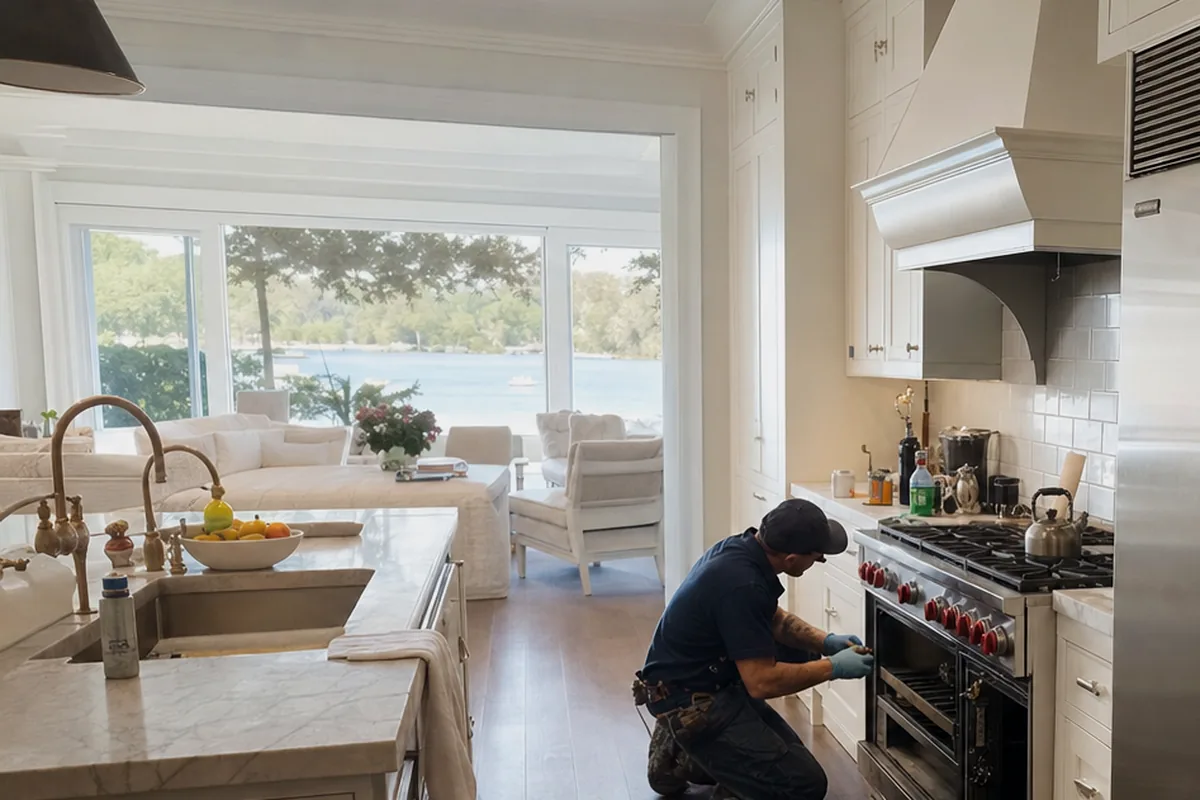
A large share of the housing in the numbered-street core of Jacksonville Beach, and in the older parts of Atlantic and Neptune Beach, is beach cottages that have been opened up. A wall comes out, a long counter goes in, and a complete modern cooking package lands in cabinetry that was framed for a much smaller appliance set.
The appliances are fine. The openings frequently are not, and the resulting failures get blamed on the appliance.
Clearance is a specification, not a suggestion
Every built-in has an installation specification: cutout width, height and depth, clearance behind and above, and a defined path for cooling air in and out. Those numbers exist because the appliance sheds heat into that space.
What we find in retrofitted cottage kitchens:
- A wall oven in an opening shallower than specified, with the gap behind it closed up so the trim sits flush against a face frame that was never square to begin with.
- A cooktop over a drawer that has been fitted deeper than the manufacturer allows, blocking the intake path the electronics depend on.
- A warming drawer or microwave drawer boxed in on three sides with no relief.
- Insulation stuffed into a cavity “to keep the heat out of the cabinet”, which does exactly the opposite for the appliance.
The result in every case is the same: the control electronics run above their design temperature for the entire life of the appliance. They still work. They just fail years earlier than they should, and they fail again after replacement, because nothing about the environment changed.
If we replace a board and do not tell you the opening is wrong, we have sold you the same part twice. So we measure the opening at the first visit and put the numbers on the invoice.
The circuit problem
The second recurring issue in older beach houses is electrical. A modern cooking package expects dedicated circuits at defined ratings. Cottage wiring that has been extended over decades often shares circuits, runs undersized conductors to a kitchen that has tripled its load, or terminates at connections that have oxidised in humid coastal air.
The symptoms are misleading. A 240-volt appliance with one open leg shows a lit display, a turning fan and no heat — a dead circuit that looks like a dead appliance. A cooktop on a marginal supply drops zones under load and appears to have a failing power module. A loose lug heats, oxidises further, and gets worse.
We test supply at the appliance before we open anything, because the cheapest possible outcome is that the appliance is not broken. If the fix is on the electrical side, that is an electrician’s work and we will tell you so rather than improvising.
Venting an old house
Cottages leak, which is why a big hood in an old beach house usually has enough make-up air by accident. The problem here is the duct: retrofit runs that are too long, have too many turns, drop to a smaller diameter partway, or terminate at a wall cap whose damper has corroded partly shut in the salt air. The blower tests perfectly and the hood still does not capture.
What to do about it
If you are planning a remodel, get the installation specifications for the actual models before the cabinetmaker cuts anything. It is a free document and it is the cheapest insurance in the project.
If the kitchen is already built and an appliance keeps failing in the same way, have the opening measured against the specification before buying another control board. It is a ten-minute check, and it is the difference between one repair and a recurring one.