Wolf wall ovens
Wall oven runs cold, overshoots, or never reaches set point
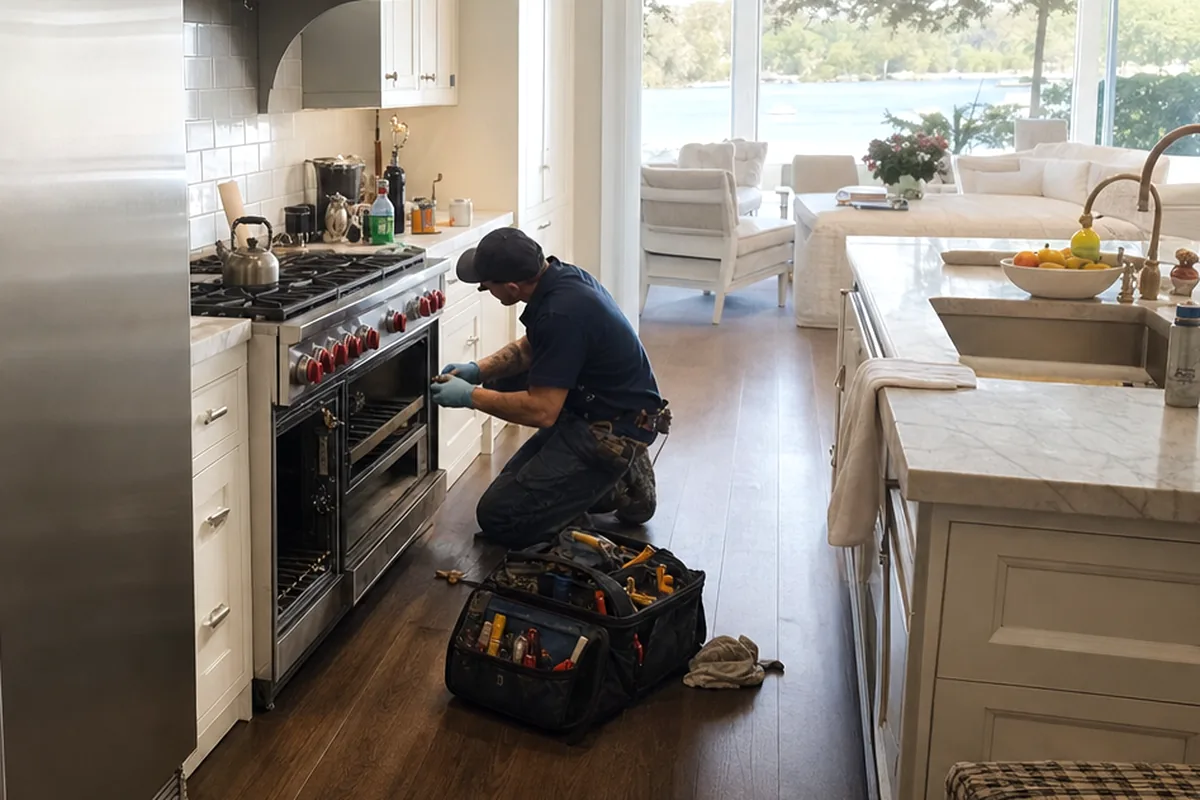
“Not heating” covers four different faults, and they are worth separating before anyone starts quoting parts. An oven that produces no heat at all is a different job from one that heats to the wrong number, and both are different from one that heats correctly and then quits forty minutes in.
No heat at all
On an electric wall oven the first thing we check is whether both legs of the 240-volt supply are present at the appliance. A single open leg at the breaker or at a corroded lug will leave the control board lit, the fan turning and the display perfectly normal while the elements do nothing. It looks like a dead oven and it is a dead circuit. This is common enough in older beach houses that we test it before we open anything.
If the supply is good, we measure element resistance and look for the classic break: a bake or broil element that has blistered at one point and opened. A failed element sometimes shows a bright scar; often it looks fine and only the meter tells you.
Heats to the wrong temperature
Every oven drifts. The question is whether it is drifting because of the temperature sensor or because of airflow. The sensor is a resistance probe: its resistance changes predictably with temperature, so a sensor reading out of range at room temperature is condemned on the spot. A sensor that reads fine cold but drifts hot in service is harder, and that is why we log cavity temperature against set point through a full cycle rather than trusting a single spot reading.
Before replacing anything we check calibration and the door. A door that no longer pulls square against its gasket bleeds heat from one corner, and the control compensates by running the elements longer. You get slow preheat, an uneven bake, and a browning pattern that always favours one side of the rack. On the island, hinge pins stiffen with salt and grease until the door stops closing to the same position it did when new — which means a “calibration” problem is sometimes a hinge problem.
Heats, then quits
An oven that shuts down partway through a long cycle is usually protecting itself. Wall ovens have thermal cut-outs and the control monitors its own temperature. If the cooling fan path is restricted, or the appliance is installed in an opening tighter than its specification, the electronics get hot and the oven stops. We see this in kitchens where a wall oven was fitted into a cabinet built for something shallower and the required clearances were closed up to make the trim sit flush. Replacing the board without fixing the opening buys you another board failure.
Broil but no bake, or bake but no broil
That pattern points at the relay board rather than the elements — one relay contact has welded or burned while the other still switches. It can also be a single failed element, so we test both before deciding. Relay boards fail more often in houses that take repeated storm-season voltage events, which is most of them here.
What the visit looks like
We measure supply voltage at the appliance, element resistance, sensor resistance cold, and cavity temperature against set point through a preheat and a hold. We check the door seal, hinge action and the installed clearances at the same time, because a temperature complaint that comes back in six months usually came back for one of those reasons.
You get a written number before any part is ordered. Parts are genuine OEM, and we tell you plainly when an oven is old enough that the sensible move is to stop spending on it.
If your oven has stopped heating entirely and the house has recently had a power event, mention it when you call. It changes what we bring.
Money, before you book
What does this repair usually cost on a Wolf wall oven?
Most of what we are called out for on this island lands between $180 and $680, parts and labor together, once the panel is off and the fault is known.
| What gets replaced or put right | Usual range |
|---|---|
| Oven thermostat or temperature sensor | $180–$520 |
| Convection fan or motor | $250–$680 |
| Diagnostic visit, credited to the repair | $80 |
Flat $80 diagnostic covering the visit and the full diagnostic sequence, credited toward the repair once you approve the work. A range rather than one number, because the firm figure is written down after the diagnosis and a range is what you can act on before it. The whole band table →
Owner reports
What owners said after this repair
4.4 out of 5 from 79 published reports. Each one is a single visit, in the words of the person who paid for it.
The oven quit halfway through a long roast twice in one week. He found the limit tripping because the opening is tighter than the specification, which is joinery and not his trade, and said so plainly rather than selling me a part.
Lachlan H.
The thermal cut-out kept dropping the oven out mid bake. He did not simply reset it and leave: he worked out that the cooling fan was slowing and replaced that as well, which is why it has not happened again.
Opal S.
The upper cavity of the double oven had gone cold while the lower one was fine. He found a broken lead at the terminal block behind the trim and repaired it, and the discolouration there told the whole story.
Fabian E.
Questions
Asked about this fault
The display reaches temperature but the cavity has not. Which is lying?
- Neither, usually. The display is reporting what the sensor tells it, and a sensor reading high sends the control the signal it needs to stop heating early. We measure the cavity independently rather than trust either number, because a calibration adjustment and a failed element look identical from the front.
It heats, then cuts out partway through a long roast. Why?
- A thermal limit doing its job, most often. When a built-in sits in an opening tighter than its specification, or its cooling air path is restricted, the appliance runs above its design temperature and trips on the longest cycles first. Replacing the part without correcting the opening buys a second failure.
What does oven heating work come to?
- A thermostat or temperature sensor lands in the $180–$520 band. A convection fan or motor sits in the $250–$680 band, and a failed control board in the $450–$1,160 band. The $80 diagnostic is the same figure whichever of the three it turns out to be.
Book a diagnostic
Tell us the model and what it is doing. We come to the island, find the fault, and put the number in writing.
- $80 flat diagnostic, credited toward the repair
- You get a written estimate before any part is ordered or any labor begins.
- 90 days on labor, 365 days on parts
- Mon–Fri 8–6 · Sat 9–4 · Jacksonville Beach and the beaches