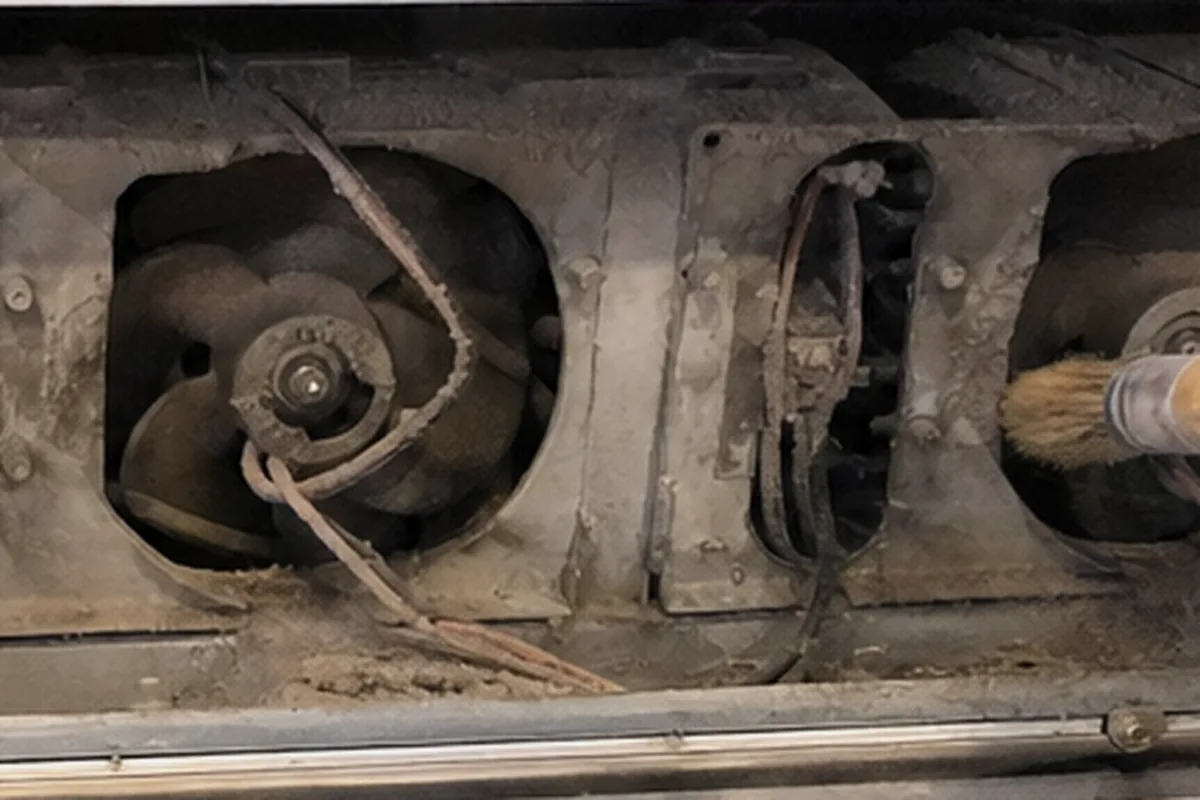
A ventilation hood is the only appliance in the house whose job is to move outside air. In a beach kitchen that means it draws chloride-laden air across bare and galvanised metal, every day, for years. Nothing else in the room gets that exposure, which is why the hood is usually the first thing we are called about.
The order it fails in
Stage one: noise. The blower wheel picks up a film of grease and salt, then loses a flake of it. The wheel is now out of balance and you hear a low rattle or hum at the top speed you never used to notice. Nothing is broken yet.
Stage two: capture. An unbalanced, partly fouled wheel moves less air. The first sign is smell — last night’s cooking still in the house the next morning, or steam drifting past the front edge of the hood instead of being pulled in. People blame the cook. It is the wheel.
Stage three: the housing. Behind the baffles, the housing and any galvanised seam start to show rust bloom. Once the coating is gone the corrosion runs, and it runs faster in a house where the sliders stay open.
Stage four: the motor. Bearings that have been carrying an unbalanced load for a couple of seasons start to draw more current and run hotter. This is the stage where a cheap service call turns into a blower assembly.
Where the blower is matters
Not every hood puts the blower in the same place, and the location changes the clock. An integrated blower inside the canopy lives in the kitchen and sees the air the room sees. An in-line blower in the attic sees the same air but in a hotter, less accessible space, so problems go unnoticed longer. An exterior blower mounted on the wall or roof is quieter in the house and worse off in every other respect: it is outdoors, on the ocean side of a coastal building, taking direct salt deposition on its housing and its motor enclosure.
If your hood is quiet for its size, find out where the blower actually is before you assume nothing needs looking at. The quietest installations are usually the most exposed ones.
The cap is part of the system
The wall or roof cap at the end of the duct corrodes too, and it does it out of sight. Dampers seize partly shut, and screens fitted to keep animals out clog with lint and salt crust. A blower in perfect condition behind a throttled cap still fails to capture, and no amount of work on the appliance will fix it. We check the termination on every hood call for that reason.
What actually helps
Run the hood on a lower speed for longer rather than blasting it for five minutes — the wheel loads up less and the room clears better. Take the baffles out and wash them properly on a schedule you will actually keep; if you cannot see light through them, they are not filtering, they are storing. Once or twice a year, look at the wheel itself with a torch. A visible ridge of deposit on the blades is your cue to book a clean before it becomes a balance problem.
If your hood is on an exterior wall on the ocean side, expect the whole sequence to run faster than the same hood two miles inland. That is not a defect. It is the address.
When to call
Call at stage one or two, when it is still noise and airflow. A wheel clean, a balance check and a housing inspection is a small job. A seized blower with a rusted-through housing is a parts job, and coastal houses reach that point sooner than anyone expects.