Wolf ventilation hoods
Ventilation hood: weak capture, rattle, dead blower
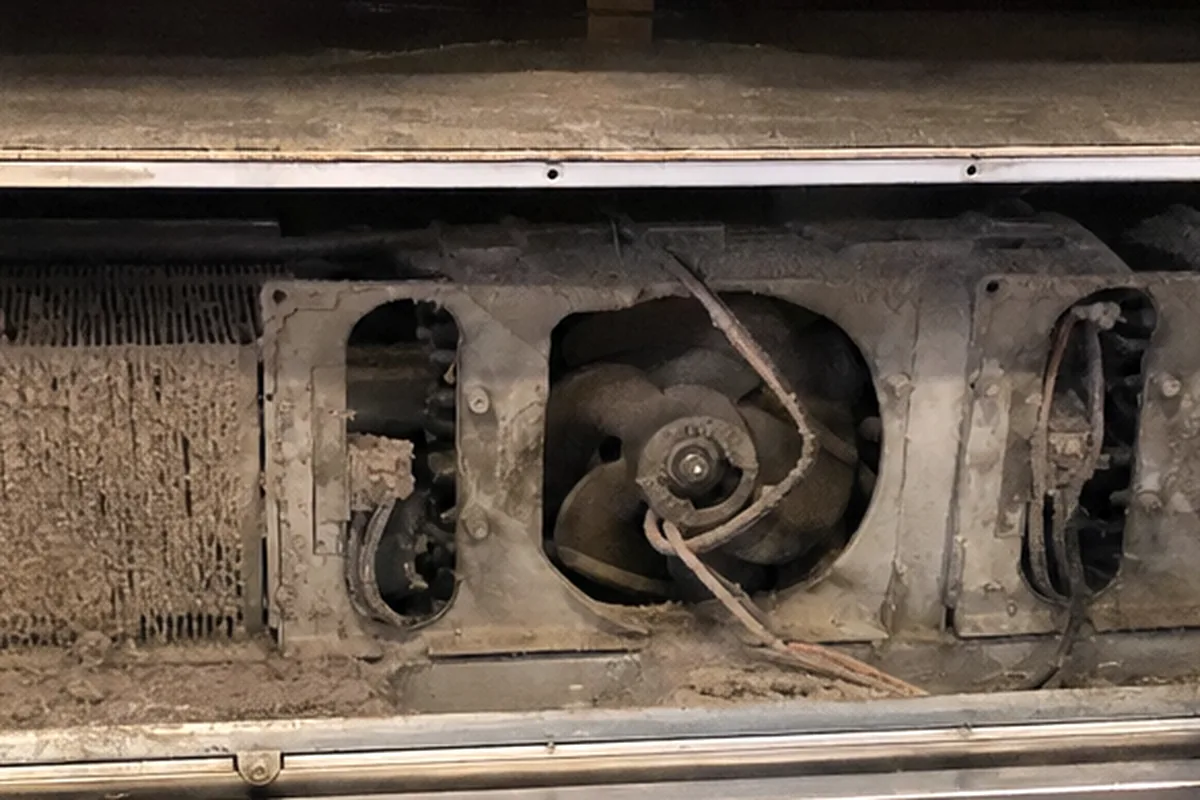
A hood has one job — move air out of the room — and on the barrier island it does that job with air that carries chloride. Nothing else in the kitchen has that duty cycle across bare metal, which is why the hood is the appliance we get called about most often here and why it fails in a predictable order.
Rattle and hum
The first complaint is almost always noise, and the cause is almost always the blower wheel. Grease and salt film build unevenly on the blades. A flake comes off one side, the wheel is out of balance, and you hear it at the speed you use least often. Nothing is broken at this point. A wheel clean and a balance check is a small job.
Left alone, an unbalanced wheel loads the motor bearings continuously. Bearing noise is different — a dry whirr or a growl that does not change when the wheel is cleaned — and it means the blower assembly is on the clock.
Weak capture
The second complaint is that the hood no longer catches. People blame the cook, or the pan, or the recipe. Usually it is one of three things.
Baffle filters that have stopped filtering. If you cannot see light through the baffles, they are not separating grease, they are storing it, and they are a restriction. They are dishwasher-safe by design and most people wash them far too rarely.
A fouled or corroded wheel moving less air than it is rated for. Same wheel, same motor, less flow.
Or make-up air. A tight, well-sealed house cannot exhaust what it cannot replace. A high-capacity hood in a modern sealed build will pull itself into a stall unless something lets air back in. Older beach cottages leak enough to feed a hood by accident; new construction in South Jacksonville Beach often does not, and that is an installation issue rather than an appliance fault.
The housing and the ductwork
Behind the baffles, the housing and the duct collar are where salt does its quiet work. Rust bloom on a galvanised seam is the visible stage; by then the coating is already gone. Where the blower is remote — in-line in the attic or mounted on the exterior wall — exposure is worse again, and an exterior blower housing on the ocean side of a house ages faster than the same unit two miles west. That is not a defect, it is the address.
We also check the roof or wall cap. A damper that has corroded partly shut, or a screen that has clogged with lint and salt crust, throttles the whole system while the hood itself tests perfectly.
Controls and speed faults
A hood stuck on one speed, or unresponsive to the controls, is usually the control board, the speed control, or the harness between them. Salt film across a switch body or a connector shell gives current a path it should not have. We check for corrosion at every connector before condemning a board, because a cleaned and re-terminated connection is a far better outcome than a board that will fail again for the same reason.
What the visit looks like
We pull the baffles, inspect and photograph the wheel and housing, check bearing condition by hand and by sound, test each speed at the control, verify the damper opens fully, and measure what the hood is actually drawing at the capture edge rather than what the badge claims. Then you get a written estimate.
Call at the rattle stage. A wheel clean and a housing inspection is a modest visit; a seized blower behind a rusted-through housing is a parts job, and coastal kitchens get there sooner than anyone expects.
Money, before you book
What does this repair usually cost on a Wolf ventilation hood?
Most of what we are called out for on this island lands between $250 and $1,160, parts and labor together, once the panel is off and the fault is known.
| What gets replaced or put right | Usual range |
|---|---|
| Control board or touch panel | $450–$1,160 |
| Convection fan or motor | $250–$680 |
| Diagnostic visit, credited to the repair | $80 |
Flat $80 diagnostic covering the visit and the full diagnostic sequence, credited toward the repair once you approve the work. A range rather than one number, because the firm figure is written down after the diagnosis and a range is what you can act on before it. The whole band table →
Owner reports
What owners said after this repair
4.4 out of 5 from 79 published reports. Each one is a single visit, in the words of the person who paid for it.
Smoke hung in the kitchen whatever setting we used. He got up on the roof, found the flap on the cap seized with rust and the screen packed with blown sand, and cleared both. The room stays clear now.
Alonzo W.
The blower stopped altogether. He replaced it and the airflow is right again, but the new unit hums at a pitch the old one never did. I was told that is normal for the part and I am still getting used to it.
Duncan H.
Steam rolled past the front lip at whatever speed we used. He measured the pull at the baffles, found the house too tight to feed it, and explained what a make up air path would do. He balanced the wheel as well.
Rufus M.
Questions
Asked about this fault
The fan sounds fine but the steam still rolls out. Why?
- Noise and capture are separate measurements. A blower wheel loaded with old grease and salt film still spins and still sounds like a hood, while moving a fraction of the air it was designed to move. Capture also fails when the duct or the roof cap is restricted, which is checked before anything is replaced.
Is the rust behind the baffles a reason to replace the hood?
- Usually not on its own. Salt reaches the blower wheel and the galvanised housing first, and a wheel or a motor can be replaced inside the housing that is already in the wall. Replacement becomes the sensible answer when the housing itself has lost section, not when there is bloom on the surface.
What is a hood blower repair likely to cost?
- A motor or blower assembly falls in the $250–$680 band. A speed control or a dead touch panel sits higher, in the $450–$1,160 band, because the part itself carries most of it. Both are quoted in writing after the baffles are out.
Book a diagnostic
Tell us the model and what it is doing. We come to the island, find the fault, and put the number in writing.
- $80 flat diagnostic, credited toward the repair
- You get a written estimate before any part is ordered or any labor begins.
- 90 days on labor, 365 days on parts
- Mon–Fri 8–6 · Sat 9–4 · Jacksonville Beach and the beaches