Wolf convection steam ovens
Convection steam oven: water, level and weak-steam faults
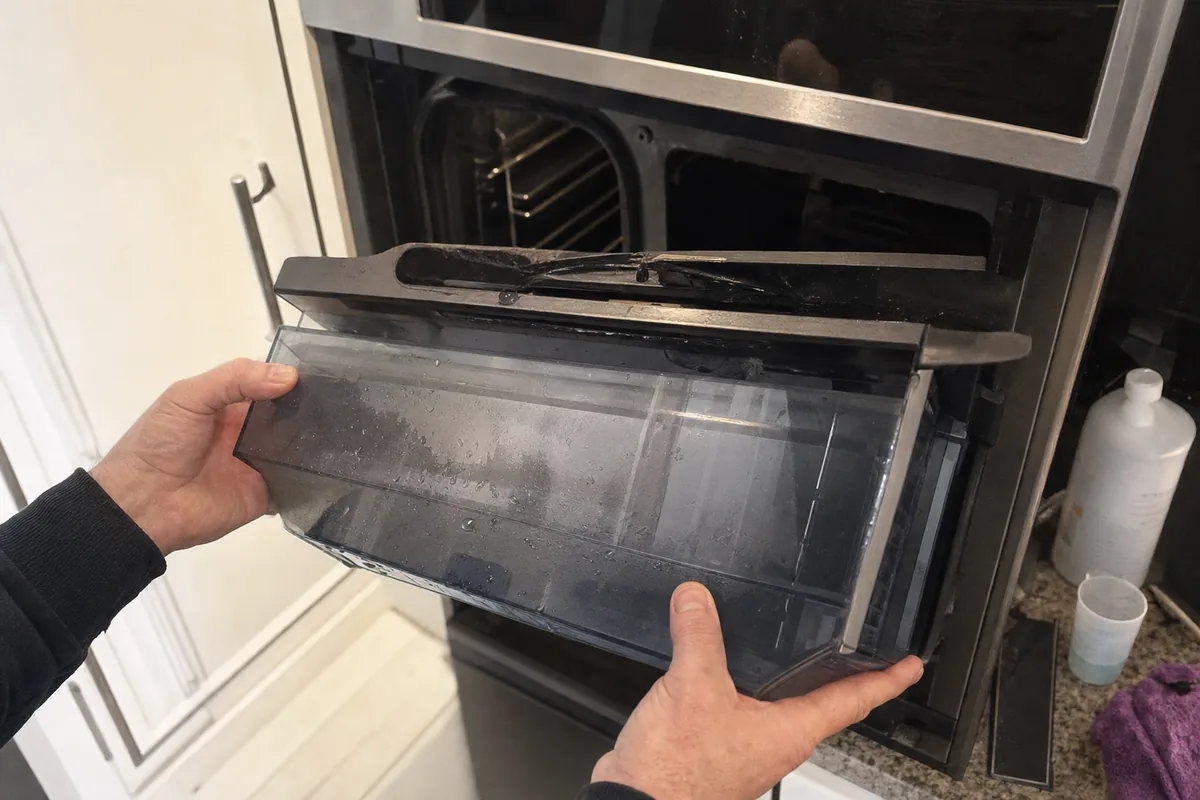
A convection steam oven is the only appliance in a Wolf kitchen that turns tap water into vapour and keeps everything the water was carrying. That single fact is behind most of the faults we are called out for on this island, and it is also why the same complaint can have four different causes at four very different prices.
Where the deposit actually goes
It does not build evenly. It concentrates in three places: the boiler or steam generator surface, the level-sensing hardware, and the small water passage between the pump and the cavity.
On the heating surface it acts as an insulator. The element has to run hotter to put the same energy into the water, so surface temperature climbs, the element ages faster, and steam generation slows. You notice it as thinner steam and food that comes out drier than it used to.
At the level sensor it is worse than an insulator — it is a liar. A coated sensor tells the control there is no water when the reservoir is full. That is why “empty reservoir” messages with a full reservoir are so often a cleaning problem rather than a failed part, and why replacing the sensor without addressing the deposit puts you back in the same place inside a year.
In the water passage it simply narrows the bore. Flow drops, the pump works against a restriction, and the cycle either runs long or never reaches the humidity it is aiming for.
The faults that are not about water at all
Weak steam is a symptom, not a diagnosis, and two of its causes sit outside the water system entirely.
The first is the door. A gasket that has hardened, or a hinge that has stiffened enough that the door no longer pulls square, leaks humidity continuously. The control responds by running longer, which reads to the owner as an oven that has lost its power. Nothing in the water system is wrong, and cleaning it changes nothing.
The second is the cavity drain and the fan path. A drain that is partly blocked leaves water standing after the cycle, and a convection fan or its seal that has been running in a wet cavity for years behaves differently from a dry one. Both are mechanical, both are visible, and both get missed if the first assumption is that the boiler must be at fault.
Plumbed installations
A plumbed steam oven has a supply line, a shut-off and usually a filter cartridge on it. The cartridge is the cheapest item in this whole page and the one most often forgotten, because a plumbed oven removes the one moment each week when somebody would otherwise handle the reservoir and notice a problem.
We check that whole line before touching the appliance, since an unchanged filter is common, cheap and directly responsible for faster fouling downstream.
When cleaning is no longer enough
There is a point past which chemistry cannot recover the appliance. If the oven has gone several years untreated, the deposit on the boiler surface can be thick and adherent enough that a normal cycle only takes the top off it. Symptoms that do not improve afterwards — still-thin steam, still a level fault, still a long cycle — usually mean hardware: a fouled generator, a restricted line, a tired pump, or a level sensor that has been etched rather than coated.
That is a parts job, and we will say so before you spend money on a third cleaning cycle that will not work. Parts are ordered against the model and the serial, because sensing hardware and control boards are revised inside a production run, and the lead time goes on the written estimate rather than turning up as a surprise.
What the visit looks like
We inspect the reservoir seat and seal, the inlet, the cavity floor and the drain path, then run a cycle and watch how quickly the cavity fogs and how the control reports level. Where the oven is plumbed rather than filled by hand, we check the supply, the shut-off and whatever filtration is on it, because a filter nobody has changed is common and cheap to fix.
The diagnostic is a flat fee, credited toward the repair when you approve the work. You get a written estimate before any part is ordered, genuine OEM parts, and a maintenance interval based on how the appliance is actually being used rather than a number copied out of a manual.
Money, before you book
What does this repair usually cost on a Wolf convection steam oven?
Most of what we are called out for on this island lands between $180 and $710, parts and labor together, once the panel is off and the fault is known.
| What gets replaced or put right | Usual range |
|---|---|
| Convection fan or motor | $250–$680 |
| Door hinge, glass or seal | $200–$710 |
| Oven thermostat or temperature sensor | $180–$520 |
| Diagnostic visit, credited to the repair | $80 |
Flat $80 diagnostic covering the visit and the full diagnostic sequence, credited toward the repair once you approve the work. A range rather than one number, because the firm figure is written down after the diagnosis and a range is what you can act on before it. The whole band table →
Owner reports
What owners said after this repair
4.4 out of 5 from 79 published reports. Each one is a single visit, in the words of the person who paid for it.
Water was leaking out of the bottom of the door during a cycle. He found the lower seal had shrunk and hardened, fitted a new one, and adjusted the catch so the door pulls evenly across the whole face.
Rosa T.
Cycles were ending early with water still standing in the base. The drain had silted up. He cleared it and checked the fall on the hose behind the unit, which had been kinked when it was pushed back in.
Celia N.
The steam oven ran full cycles but the glass never fogged. He traced it to a blocked inlet screen and a sluggish valve, cleaned one and replaced the other, then ran a cycle with me watching so I could see the difference.
Imogen T.
Questions
Asked about this fault
It asks to be descaled again straight after descaling. Why?
- Because the deposit is not where the cycle can reach it. Descaling addresses the water path; scale that has built on the heating surface acts as an insulator and keeps the element running hotter for longer, which the control reads as a system that still needs treating. The fix is mechanical, not another cycle.
The reservoir is full but the oven says it is empty. What is that?
- A level-sensing fault rather than a water fault. The sensor, its float or the contacts behind it can be fouled by deposit or corroded by damp, and the oven then behaves exactly as it should for the reading it is being given. It is diagnosed by measurement, not by refilling.
What do steam oven repairs cost?
- Water-system work usually involves the temperature sensing or the heating circuit, in the $180–$520 band. Where the control board itself has failed, the $450–$1,160 band applies. The $80 diagnostic covers the full sequence and is credited against the repair.
Book a diagnostic
Tell us the model and what it is doing. We come to the island, find the fault, and put the number in writing.
- $80 flat diagnostic, credited toward the repair
- You get a written estimate before any part is ordered or any labor begins.
- 90 days on labor, 365 days on parts
- Mon–Fri 8–6 · Sat 9–4 · Jacksonville Beach and the beaches