Wolf rangetops
Rangetop: simmer drop-out, griddle drift, charbroiler patchiness
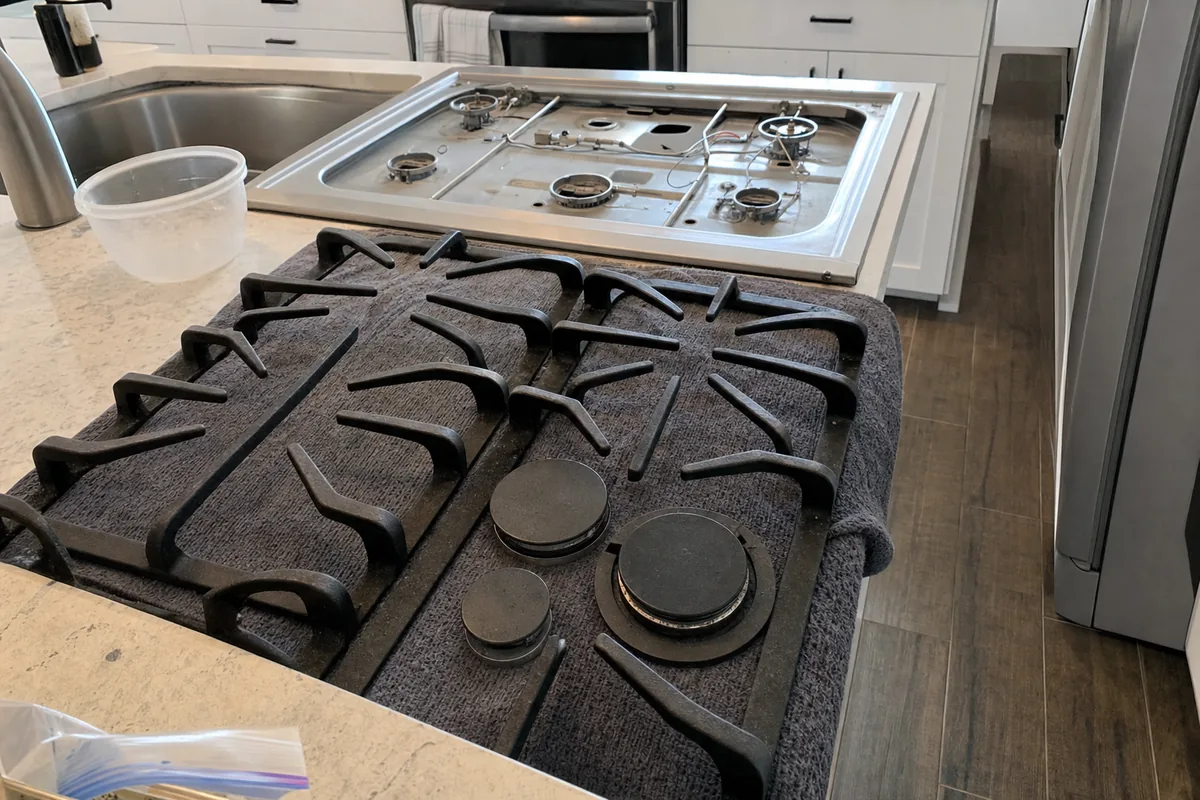
A rangetop is a cooking surface with no oven under it, which means everything that goes wrong is in the burners, the valves, the gas supply or the surface accessories. It also means the whole assembly sits directly over cabinetry and directly under the hood — so it collects grease from above and salt from the room.
Simmer that will not hold
The dual-stacked sealed burners on a Wolf rangetop are designed to run a genuine low flame, and a low flame is unforgiving of anything blocking a port. At full output a partly obstructed burner still looks fine. At the simmer setting there is not enough gas velocity to carry past an obstruction, so the flame goes ragged, lifts, or extinguishes.
Three causes, in the order we find them:
- Ports. Boil-over residue, plus salt-driven pitting of the port ring, and the cap no longer meters air and gas the way it was machined to. A pitted cap is replaced, not cleaned — the geometry is gone.
- Cap seating. Caps come off for cleaning and go back a few degrees out of register. A burner will misbehave at low flame long before it misbehaves at high flame.
- The valve. A valve that has stiffened, or whose low-flame adjustment has drifted, will not deliver the small, stable flow the simmer setting needs. We measure manifold pressure before touching an adjustment, because a supply problem set right at the burner just moves the fault somewhere else.
If only one burner misbehaves, it is that burner. If every burner is weak at low setting, look upstream at pressure and regulation.
Griddle temperature
An integrated griddle is a thick plate with its own burner and its own thermostat sensing plate temperature, not air temperature. Cold corners with a hot centre usually mean a burner that is not spreading — ports obstructed on one side, or a burner sitting out of position after a deep clean.
A griddle that heats evenly but reads wrong is a calibration or sensor issue. We put a surface thermometer on the plate at several points, hold each setting, and compare against the dial. That gives a real curve to judge against instead of a guess. Warped plates are the other cause and are visible: a plate that no longer sits flat has an air gap under it, and air is an insulator.
Infrared charbroiler
An infrared charbroiler works by heating a ceramic or metal emitter until it radiates. Patchy glow means the emitter surface is fouled, cracked, or that the burner beneath it is not firing evenly across its length. Grease that has carbonised into the emitter face changes how it radiates and how it lights. Slow ignition on a charbroiler is usually the electrode and its ground path, same as any other burner, and out here the electrode is often pitted rather than merely dirty.
Salt on a rangetop
Grates, caps, bezels and the control panel all take chloride from the room air and never get rinsed. Grate feet corrode where they contact the surface, caps pit at the ports, and the stainless bullnose develops the fine brown speckle people mistake for rust from the inside out. It is surface contamination, it starts within months at this distance from the water, and it is preventable with a routine rather than a product.
What the visit looks like
Manifold pressure, spark at each electrode, port and cap condition, valve action through the full travel, griddle plate temperature at multiple points, emitter condition on a charbroiler. Written estimate before parts, genuine OEM components, and no gas work attempted on a lit appliance. If you smell gas at the rangetop, shut the supply off at the valve and step outside before calling anyone.
Money, before you book
What does this repair usually cost on a Wolf rangetop?
Most of what we are called out for on this island lands between $180 and $710, parts and labor together, once the panel is off and the fault is known.
| What gets replaced or put right | Usual range |
|---|---|
| Igniter or spark module replacement | $210–$550 |
| Burner valve or orifice service | $210–$710 |
| Oven thermostat or temperature sensor | $180–$520 |
| Diagnostic visit, credited to the repair | $80 |
Flat $80 diagnostic covering the visit and the full diagnostic sequence, credited toward the repair once you approve the work. A range rather than one number, because the firm figure is written down after the diagnosis and a range is what you can act on before it. The whole band table →
Owner reports
What owners said after this repair
4.4 out of 5 from 79 published reports. Each one is a single visit, in the words of the person who paid for it.
The charbroiler came up slowly and glowed in bands. He lifted the emitter, found the burner underneath partly blocked, cleared it and reset the air shutter. It comes up evenly now and a good deal faster than it did.
Verity S.
Simmer on this top was really a slow boil and sauces kept catching on me. He set the bypass adjustment on each valve, which had never been touched since it was installed, and a low setting is genuinely low now.
Willa O.
The griddle plate had warped enough to pool oil at one end. He measured it, was straight with me that it was past flattening, and fitted a new plate. He also levelled the top, which had been off since installation.
Hollis C.
Questions
Asked about this fault
Why does simmer hold on one burner and not the one beside it?
- Because simmer is the setting with the least margin. A port drilling partly closed by salt and grease, a cap sitting a fraction proud, or a valve that has drifted will all still run a high flame convincingly and drop the low one. The burner that works is the reference for the one that does not.
The griddle is hot in the middle and cool at the corners. Is that normal?
- Some fall-off at the edge is. A cold corner is not. The griddle thermostat senses plate temperature rather than air temperature, so a sensor reading late, an element with a failed section, or a plate not seated flat in its recess all show up as an uneven surface rather than as an error.
What does rangetop work usually come to?
- Burner, valve and orifice work falls in the $210–$710 band. A griddle thermostat or temperature sensor sits in the $180–$520 band. Both are quoted in writing, and the $80 diagnostic comes off whichever one you approve.
Book a diagnostic
Tell us the model and what it is doing. We come to the island, find the fault, and put the number in writing.
- $80 flat diagnostic, credited toward the repair
- You get a written estimate before any part is ordered or any labor begins.
- 90 days on labor, 365 days on parts
- Mon–Fri 8–6 · Sat 9–4 · Jacksonville Beach and the beaches